My Time with Wolves
A four-year journey into the heart of the Italian Apennines
For years, naturalist and wildlife photographer Gianluca Damiani has explored the mountains, forests and valleys of the Italian Apennines in search of one of Europe's most fascinating and controversial predators: the wolf.
My Time with Wolves is not a documentary about capturing the perfect wildlife image.
It is a story about patience, waiting and coexistence.
A journey spanning several years, the film follows wolf tracks across some of Italy's most remarkable landscapes, exploring the relationship between people and the wild world around them.
More than a film about wolves, it is a reflection on the time required to understand nature and on the profound transformation that can occur when we learn to listen to it.
Synopsis
Following a naturalist across the Italian mountains, My Time with Wolves tells the story of a long and patient search for one of Europe's most elusive predators.
Through silent waits, rare encounters and fragile moments of coexistence between people and wolves, the film explores the deep connection between wilderness and those who choose to listen to it, revealing how living alongside what we cannot control can transform the way we see nature—and ourselves.
The story behind the film
My Time with Wolves took four years to complete.
Frozen dawns, long days in the forest, tracks disappearing into fresh snow, and weeks without a single wolf sighting became part of the process.
Like the wolves themselves, the film grew slowly.
Shot across eight Italian regions, the documentary follows the rhythm of the natural world, accepting that the most meaningful encounters often emerge only after long periods of uncertainty and silence.
Produced independently, the project is the result of thousands of hours spent in the field, searching not only for wildlife footage, but for stories, relationships and a deeper understanding of our connection with the wild.
A life alongside wolves
For Gianluca Damiani, wildlife photography is more than a profession.
It is a way of experiencing and understanding the landscape.
For more than a decade he has documented Italian wildlife, dedicating much of his work to observing the large predators of the Apennines.
Throughout the film, he invites viewers into a world shaped by patience, respect and careful observation, revealing how the search for wolves gradually became a philosophy of life.
Living alongside large predators
The return of the wolf is one of Europe's most significant wildlife conservation stories.
Yet the return of large predators also brings new challenges and responsibilities.
Shepherds, livestock farmers, researchers, photographers and local communities all engage with a complex reality that rarely offers simple answers.
Rather than taking sides, My Time with Wolves explores these different perspectives, revealing coexistence as a fragile balance that must be negotiated day after day.

The silhouette of a wolf stands against the fading light, a fleeting presence on the edge of the wild.
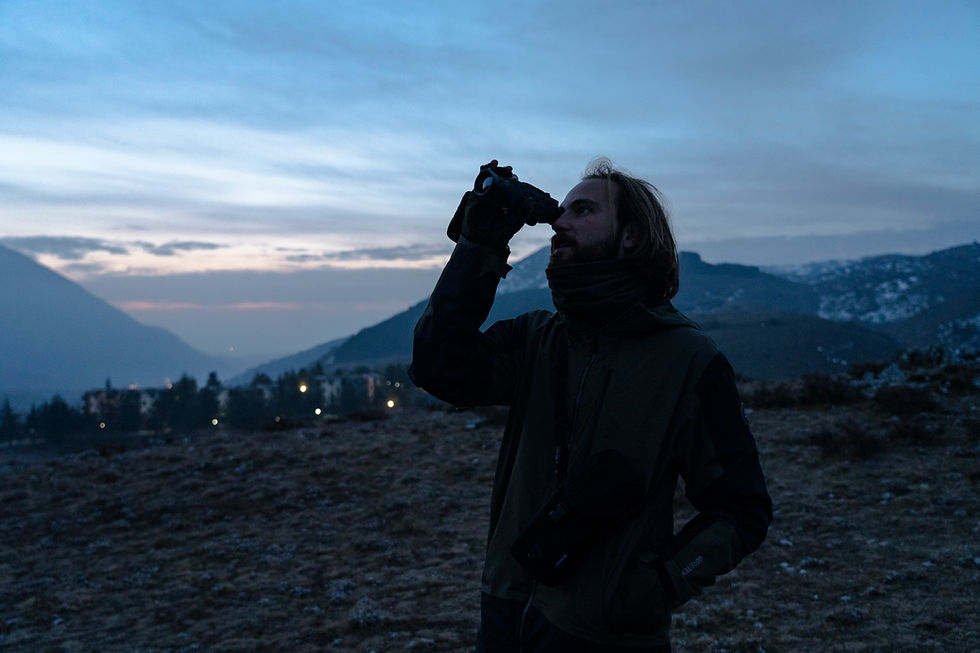
Gianluca watches wolves from a monitoring location.

A lone wolf surveys a snow-covered valley, moving through a landscape shaped by silence, distance and survival.
The silhouette of a wolf stands against the fading light, a fleeting presence on the edge of the wild.

A wolf family from the Abruzzo Apennines that we followed for several years during the making of the film.

Director Mattia Cialoni and protaginist Gianluca Damiani tracking and filming wolves.

Mario, a shepherd from the Apennines, shares his experience of living alongside wolves and the daily.
A wolf family from the Abruzzo Apennines that we followed for several years during the making of the film.
Behind the scenes
In the coming months this section will feature:
-
Behind-the-scenes videos
-
Official trailer
-
Exclusive images
-
Production stories and field notes
-
Music Album
Screenings and events
Beginning in autumn 2026, My Time with Wolves will be presented through a series of screenings and special events across Italy and the United Kingdom.
Events will include film screenings followed by audience discussions with director Mattia Cialoni and naturalist Gianluca Damiani.
For screening enquiries:
mattia@storiedilupi.com


@ Copyright Mattia Cialoni / www.mattiacialoni.com / mattia.cialoni@gmail.com